

Closura: From Aluminium Boundaries to Energy-Producing Outdoor Spaces
The exterior of a property is no longer defined by a gate and a fence alone. It has become a more complete architectural environment, expected to provide security, privacy, shelter, additional living space and, increasingly, renewable energy. From its base in Charente-Maritime, French manufacturer Closura is adapting its industrial expertise to this broader understanding of the home.
Established in 2004, Closura initially built its reputation around made-to-measure aluminium gates and fencing for professional partners. Over time, its portfolio has expanded to include carports, pergolas, summer rooms and solar structures, reflecting the growing convergence between exterior joinery, outdoor living and domestic energy production.
The company’s name itself emerged from an idea of enclosure. During a journey to Ptuj in Slovenia in 2004, the entrance gate of an old farm provided the inspiration for “Klavzura”, later adapted into Closura. It proved an appropriate identity for a manufacturer whose products are designed to close, screen, shelter and define exterior space.
Yet Closura’s development has never been based solely on the physical product. Quality, customer service and human relationships are presented as the foundations of its partnership model. This is particularly important because the company manufactures primarily for building professionals, who must translate technical products into successfully installed projects for the end customer.
In this market, a reliable manufacturer must offer more than a broad catalogue. Dealers and installers depend on clear technical information, responsive support, consistent manufacturing and solutions capable of adapting to real site conditions. The strength of the relationship between manufacturer and professional partner can therefore influence the entire customer experience.
Closura has reinforced this model through a deliberately French supply chain. Its aluminium profiles are sourced from a French designer, extruder and powder coater whose expertise supports both design and technical development. At the same time, Closura creates specific profiles of its own, allowing the company to introduce original details and proprietary solutions into its ranges.
This balance between collaboration and internal creativity is significant. It gives a regional manufacturer access to advanced extrusion and finishing capabilities while preserving the freedom to differentiate its products. Gates, fencing and outdoor structures can therefore be developed as coherent systems rather than assembled from entirely generic components.
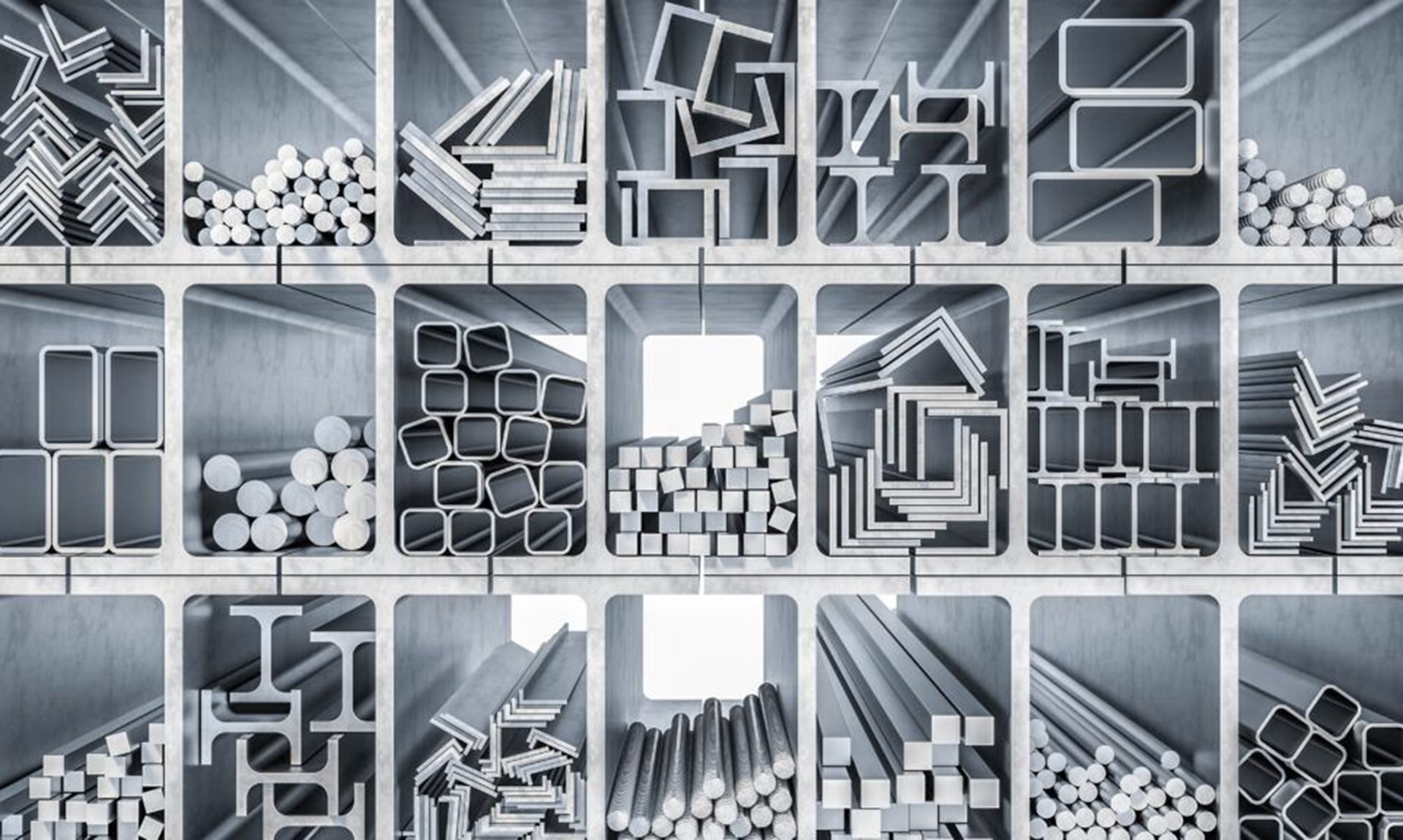
Aluminium remains central to the company’s identity. Durable, corrosion-resistant and highly adaptable, it is well suited to gates and fencing but equally relevant to pergolas, carports and lightweight exterior structures. It can support clean contemporary lines, a wide range of finishes and the structural requirements of increasingly ambitious outdoor applications.
Closura nevertheless describes itself first as a joinery business. Although it works with hot-extruded profiles rather than timber alone, its activity still depends on many of the same principles: accurate measurement, careful assembly, knowledge of materials and the ability to translate a specific opening or exterior space into a made-to-measure solution.
Under the leadership of President Christophe Charles, the company is now placing greater emphasis on adaptability. His message reflects an industry facing rapid changes in customer expectations, energy use, environmental responsibility and the function of exterior space. Each new challenge is treated as an opportunity to reconsider methods and develop more relevant solutions.
This philosophy became particularly visible in the company’s recent diversification. During 2024, Closura structured a broader offer of pergolas, pool houses, carports and outdoor kitchen shelters across several ranges. The programme formed part of a wider development strategy intended to increase production capacity, expand the company’s market presence and support future recruitment and innovation.
The move is strategically important. Outdoor structures are no longer peripheral additions reserved for large homes. Pergolas and covered terraces can extend the usable living area, carports can protect vehicles without the visual or structural weight of a conventional garage, and compact summer rooms can create new places for relaxation, dining or entertaining.
Closura is also connecting this expansion with decentralised energy generation. Solar carports and photovoltaic shade structures allow surfaces traditionally used only for protection to perform a second function: producing electricity. In this context, the shelter above a vehicle or terrace becomes part of the property’s energy infrastructure.
The company introduced a solar carport in 2024 and subsequently presented a Plug & Play photovoltaic fence. These developments reveal a wider shift in the role of exterior joinery. Boundary and shelter products can increasingly integrate technologies that contribute to energy autonomy without abandoning their architectural purpose.
This does not mean that every exterior structure must become a power station. Rather, it demonstrates how familiar building elements can acquire additional value when design and technology are considered together. A carport can offer weather protection and generate energy. A fence can provide privacy while supporting photovoltaic production. A pergola can regulate sunlight and extend the seasonal use of a terrace.
Wood is also becoming part of Closura’s vision for future development. By combining aluminium with a renewable natural material, the company can explore warmer architectural expressions and address customers looking for a balance between technical durability and more tactile, organic finishes.
Sustainability in this context is not limited to the recyclability of aluminium. It also concerns local sourcing, product longevity, adaptable design and the ability to use exterior structures for renewable-energy production. Durable products that remain relevant over time can reduce the need for replacement, while local industrial partnerships help retain knowledge and value within the French manufacturing economy.
Closura’s position is therefore becoming more distinctive. It remains a specialist manufacturer of gates and fencing, but it is also developing into a wider provider of exterior architectural systems. The same knowledge once applied primarily to the boundary of the property is now being extended to the terrace, the driveway, the garden and the production of solar energy.
That evolution reflects a larger transformation across the building sector. Homes are expected to become more adaptable, more energy-conscious and better connected to their exterior environments. Manufacturers capable of combining dependable production with rapid product development will play an increasingly important role in this transition.
Closura’s journey since 2004 demonstrates how a regional French company can evolve without abandoning the principles on which its reputation was built. Its next phase is not a departure from gates and fencing, but a logical extension of them: from closing and protecting space to making that space more useful, more comfortable and more productive.
In doing so, Closura is helping redefine what an exterior aluminium product can be. It is no longer simply a boundary or a shelter, but a potential part of a more coherent, sustainable and energy-aware way of living.

Share This Story




news via inbox
Your source for the latest news in the fenestration industry.
