

Glass Futures joins ResponsibleGlass to shape first global standard for responsible glass
The global glass sector may be approaching a structural shift in how sustainability is defined, measured and verified. Glass Futures, the UK-based centre of excellence for glass research and innovation, has joined ResponsibleGlass, a newly established international, multi-stakeholder not-for-profit programme aiming to create the first independent global standard for responsible, low-carbon glass production.
An industry without a unified benchmark
Glass underpins modern construction, mobility, renewable energy and packaging. Yet its production remains energy-intensive, contributing an estimated 95 million tonnes of CO₂ annually. Unlike steel — which in recent years has coalesced around frameworks such as ResponsibleSteel — the glass industry has lacked a unified sustainability standard capable of aligning manufacturers, supply chains and end users under a single certification system.
ResponsibleGlass seeks to fill that gap.
Backed by major glass and industrial groups, mining standards organisations and global automotive brands including Jaguar Land Rover, the initiative is chaired by Francis Sullivan, former Head of Sustainability at HSBC. The programme brings together stakeholders across manufacturing, raw materials, automotive and civil society to co-develop an independent, globally recognised certification scheme for responsible glass production.
From principle to proof
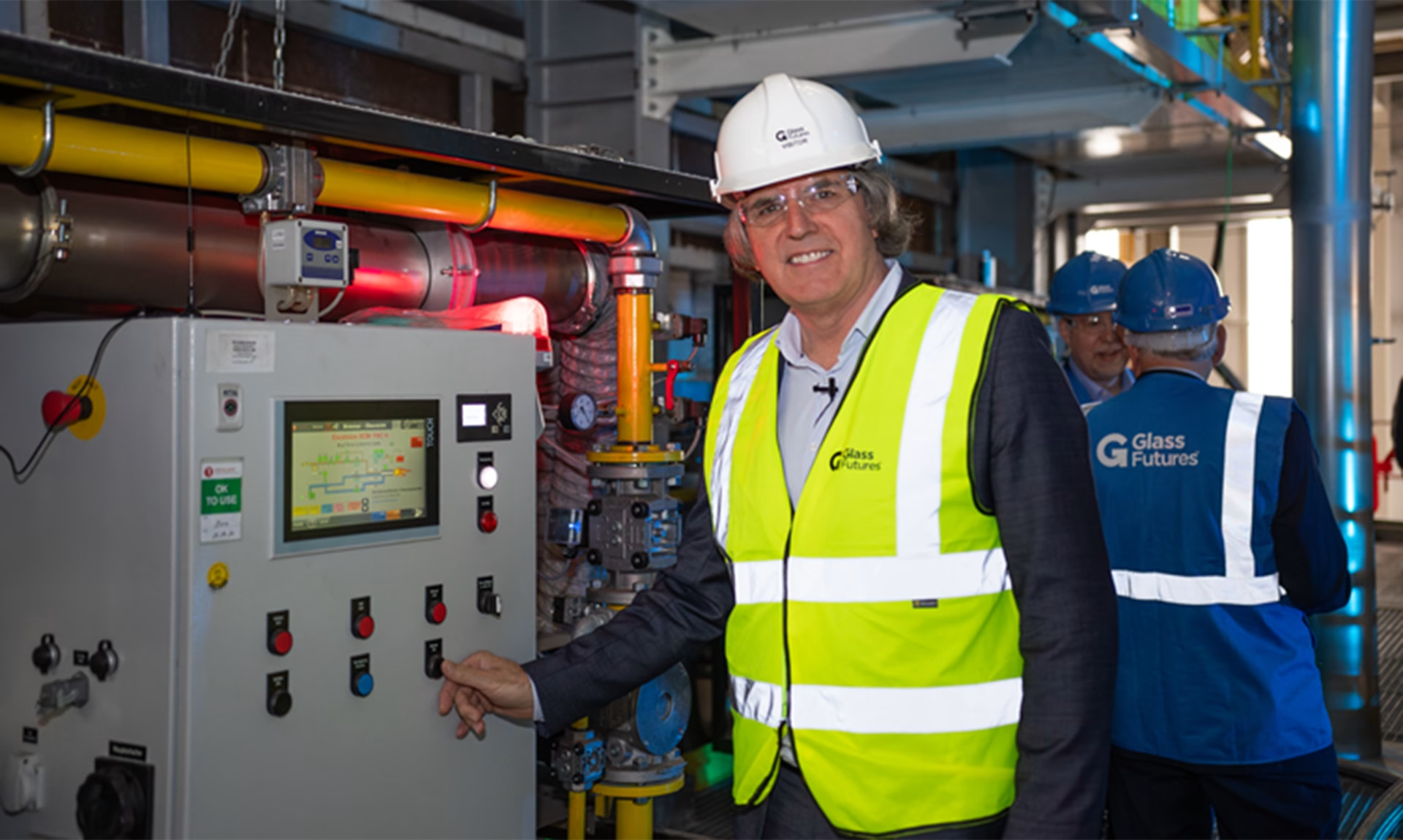
The addition of Glass Futures introduces technical depth to the programme. Opened in 2022, the organisation operates a 165,000 sq ft Global Centre of Excellence in St Helens, UK, complete with an independent pilot-scale furnace capable of producing up to 30 tonnes of glass per day.
Its remit spans hybrid-fuel and electrified furnace systems, low-carbon raw materials, circularity strategies and digital transformation in glass manufacturing. Crucially, it bridges research and industrial-scale validation — a capability central to ensuring that sustainability criteria are technically credible and commercially viable.
By joining ResponsibleGlass as a founding member, Glass Futures will contribute scientific validation, testing infrastructure and innovation expertise to the development of the ResponsibleGlass Standard. Version 1.0 is scheduled for publication later this year, providing what organisers describe as a practical blueprint for responsible production and a pathway toward global recognition.
Towards measurable accountability
The ResponsibleGlass Council — now comprising manufacturers, suppliers and major glass users from automotive to soda ash production — is progressing the first iteration of the standard. The ambition extends beyond carbon accounting to encompass transparency, circularity and supply chain accountability.
For architects, façade engineers and major contractors, a verified global standard could simplify material specification and ESG reporting, particularly as regulatory scrutiny and embodied carbon disclosure requirements intensify across Europe and beyond.
The move signals more than institutional collaboration; it suggests a maturing of sustainability governance within the glass sector. If successful, ResponsibleGlass may do for glass what established certification frameworks have done for other foundational materials — embedding measurable responsibility into the fabric of global supply chains.
Share This Story




news via inbox
Your source for the latest news in the fenestration industry.
