

Veka invests in in-house weather simulation to enhance pre-certification testing
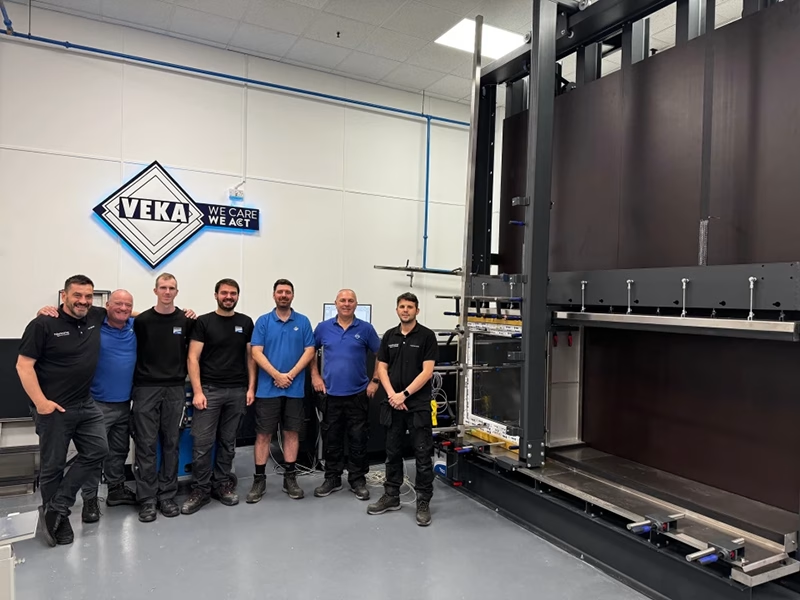
In an industry increasingly defined by compliance, classification and traceable performance data, Veka plc has expanded its technical infrastructure with the introduction of a dedicated in-house weathering facility at its workshop site.
Supplied by ift MessTec, part of ift Rosenheim, the rig enables controlled environmental evaluation of window systems prior to formal third-party certification. While not a substitute for UKAS-accredited testing, the facility is positioned as a preparatory and developmental tool — one intended to reduce uncertainty before products enter the formal validation process.
Controlled insight at an earlier stage
The installation allows Veka’s technical team to simulate wind load, pressure variation and wind-driven rain within a consistent, measurable environment. Air permeability testing quantifies airflow through assemblies under pressure in line with recognised classification standards, while a fog system visually highlights potential leakage paths — a practical diagnostic feature during system refinement.
Water tightness performance is assessed by replicating increasing wind pressure against driven rain, measured in Pascals, enabling engineers to observe thresholds for ingress. Wind deflection and pressure pulse tests evaluate structural movement across frames and glazing under sustained and repeated load cycles, capturing data on displacement and behavioural response.
Taken together, these metrics provide an early-stage performance profile of complete window configurations, supporting more informed design decisions before systems are submitted for independent certification.
Mitigating commercial risk
For fabricators operating in a market where specification demands can vary significantly by sector, pre-certification evaluation offers tangible commercial advantages. Early identification of performance limitations or configuration sensitivities may allow adjustments to hardware selection, reinforcement strategy or glazing specification prior to formal testing.
Such preparation can reduce the risk of unexpected outcomes at accredited facilities — outcomes which can carry implications for programme timing, cost and client confidence.
Collaboration within practical constraints
Veka’s approach emphasises collaborative development. Its technical team works with fabricators to assess hardware combinations, detailing strategies and intended market applications, balancing performance targets with production efficiency.
A recent project with a long-standing customer involved reviewing selected hardware on a Veka window system under defined environmental conditions. Recorded data on air permeability, water tightness and structural response provided a performance baseline ahead of external certification — enabling the fabricator to proceed with greater clarity.
Phil Gregory, Design & Development Manager at Veka, notes that the facility allows indicative testing under controlled conditions, generating documented data to inform technical decisions before systems progress to accredited routes.
Infrastructure as strategic investment
The addition of the weathering rig forms part of Veka’s broader investment in technical capability and customer partnership. In a regulatory environment where product performance is scrutinised more closely than ever, the ability to model, measure and refine systems internally reflects a shift towards proactive risk management rather than reactive correction.
For fabricators navigating tightening standards and increasingly specification-driven procurement, access to controlled environmental evaluation may prove less about competitive advantage and more about operational assurance.
Share This Story




news via inbox
Your source for the latest news in the fenestration industry.
